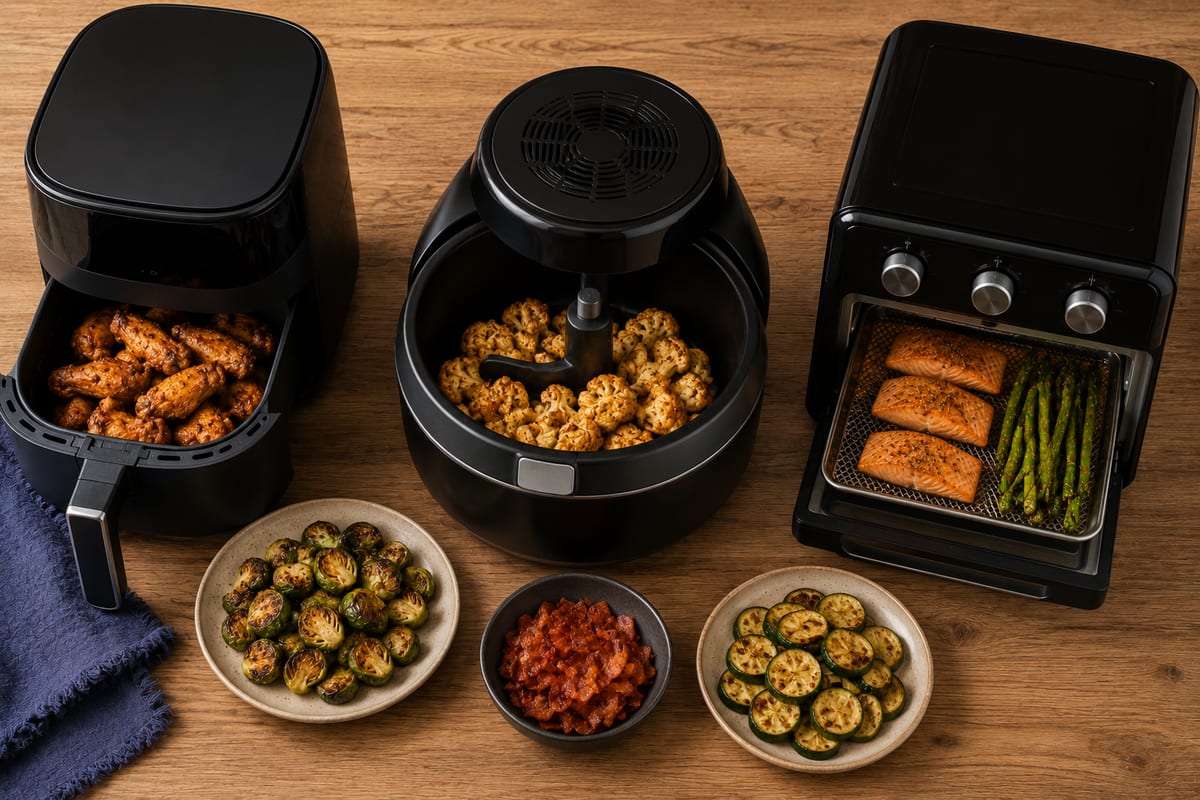
Air fryer keto recipes earn their place because the machine crisps the food a low-carb kitchen already runs on, protein and vegetables, with no flour breading and almost no oil. Most guides for this hand you a wall of recipe cards and stop. This one gives you a working reference instead: one table that lines up temperature, time, and net carbs for real dishes I have tested, the rule for turning any oven recipe into an air-fryer recipe, and an honest note on the two things the basket does badly.
Air Fryer Keto Recipes: A Low-Carb Cook's Guide
The air fryer keto recipes master table
Every row below links to a full tested recipe on this site. Air-fryer temperatures and times are the settings to start with, grouped by type. Net carbs are per serving from each recipe. Numbers are accurate as of June 2026; air-fryer models vary, so check doneness early and verify with a thermometer.
| Dish | Air fryer temp | Time | Net carbs / serving | My recipe |
|---|---|---|---|---|
| Parmesan garlic wings | 400°F | 18-22 min, flip once | about 2 g | Keto Parmesan Garlic Wings |
| Buffalo wings (steam first, then air fry) | 400°F | 15-20 min, flip once | about 2 g | Keto Buffalo Wings |
| Parmesan chicken club cutlets | 400°F | 10-14 min, flip once | about 3 g | Parmesan Chicken Club |
| Chicken shawarma | 380°F | 14-18 min, flip once | about 2 g | Chicken Shawarma |
| Crispy bacon | 350°F | 8-12 min, no flip | about 0 g | Crispy Bacon |
| Bacon jerky (low and slow) | 300°F (or lowest) | 45-70 min, flip once | about 1 g | Keto Bacon Jerky |
| Bacon egg cups | 325°F | 10-13 min, no flip | about 1 g | Bacon Egg Cups |
| Chile relleno | 375°F | 10-12 min, flip once | about 5 g | Keto Chile Relleno |
| Brussels sprouts with bacon | 375°F | 10-14 min, shake twice | about 7 g | Keto Brussels Sprouts with Bacon |
| Parmesan garlic green bean fries | 400°F | 8-10 min, shake once | about 4 g | Green Bean Fries |
| Cauliflower popcorn | 390°F | 12-15 min, shake twice | about 3 g | Cauliflower Popcorn |
| Salami chips | 375°F | 4-6 min, watch closely | about 1 g | Salami Chips |
| Parmesan crisps | skillet or oven better | cheese spreads in a basket | about 1 g | Parmesan Crisps |
| Queso fresco caprese | skillet better | cheese drips through the rack | about 2 g | Queso Fresco Caprese |
The bottom two rows are the honest exceptions. A plain cheese crisp and pan-fried queso fresco melt and run before they set, so they slide between the basket holes or weld to the surface. Make those in a dry skillet or a 400 degree F oven on parchment, where they hold their shape. The other twelve are natural fits, and the wings, bacon, and green beans take to the air fryer better than to anything else in my kitchen.
How to convert any oven recipe to the air fryer
This is the part the recipe lists leave out, and it is the one worth saving. Almost any low-carb dish written for the oven can move to the air fryer with two adjustments and a habit:
- Drop the temperature by about 25 degrees F (roughly 15 degrees C) from the oven setting.
- Cut the time by about 20 percent, then check at that mark rather than trusting it.
- Preheat for 2 to 3 minutes so the food hits hot air from the first second.
- Single layer, never crowd. Pieces touching means they steam each other instead of crisping. Cook in batches if you have to.
- Flip or shake at the halfway point so the side facing away from the element browns too.
- A light oil mist on lean food gives crisp without any breading, which is the whole point for keto.
- Check early and trust a thermometer over the timer for anything with raw meat.
The reason both numbers drop is that an air fryer is a small convection oven with a strong fan. The chamber is tight and the food sits close to the heat, so hot air hits it faster and from every side. That same airflow is why the surface dries and crisps while the inside stays moist, and why a full-size oven setting would overshoot.
Here is the rule applied to three recipes already on this site, so you can see it work. My crispy bacon starts in a cold oven and finishes flat; in the air fryer, skip the cold start, set 350 degrees F, and pull it at 8 to 12 minutes depending on thickness, since bacon fat smokes near 400. The green bean fries roast at 425 in the oven for 15 to 20 minutes; take 25 off and you land near 400 in the basket, and the 20 percent time cut plus the tighter heat brings them to crisp in 8 to 10. My parmesan garlic wings already give an air-fryer method at about 45 minutes for a paddle-style fryer like the ActiFry; a basket runs hotter and tighter, so 400 degrees F for 18 to 22 minutes with one flip gets you there, always to a 165 degree F internal reading.
What each group needs to come out right
The table gives you the settings; this is the nuance behind each group, the part that decides crisp from soggy.
Wings and chicken
Dry skin is everything. Pat wings until the paper towel comes away clean, then toss them with a little baking powder if you want extra shatter, since it pulls moisture to the surface and helps the skin brown. Lay them in one layer with space between, flip at the halfway mark, and let safety call the finish: chicken is done at an internal 165 degrees F per USDA FSIS, not at a set minute. My parmesan garlic wings wear a dry parmesan-ranch coating that crisps in the basket with no flour, and the chicken shawarma takes to the air fryer for the char it normally gets from a vertical spit. The one wing recipe with an asterisk is the buffalo wings, which I steam first to render fat and cut mess; the steam step happens off the air fryer, then the basket finishes them crisp before the sauce goes on.
Bacon and pork
Fatty pork is the easiest thing the air fryer cooks, because it crisps in the fat it renders and needs nothing added. Keep bacon at 350 degrees F rather than 400, since bacon fat smokes near the higher number, and drain the drawer between batches so the next round does not fry in a puddle. Bacon jerky is the slow exception: set the fryer low, around 300 degrees F or its lowest setting, and let the airflow dry the strips to a chew over 45 to 70 minutes, blotting the grease as they go. The fan does this well because it keeps moisture moving off the surface, though a true low-temperature dehydrator still makes the chewiest jerky. Pork and other red meats are safe at an internal 145 degrees F with a 3-minute rest, lower than poultry, so do not cook them to the wing temperature out of habit.
Vegetables and sides
Low-carb vegetables want high heat, a light coat of oil, and room to breathe. Salt and oil them before they go in, not only after, so the edges season and caramelize. Shake the basket once or twice through the cook, since the pieces touching the surface brown first. Green bean fries crisp fast at 400, cauliflower popcorn wants a couple of shakes to brown evenly, and Brussels sprouts caramelize at the cut faces if you halve them and lay the flat side down first. These are the rows where the air fryer most clearly beats the oven, because the tight, fast heat is exactly what a small batch of veg wants.
Cheese and snacks
This group splits. Sturdy, fatty snacks crisp like a dream: salami chips shrink and stiffen in 4 to 6 minutes, and bacon egg cups set gently at a lower 325 so the whites stay tender. Soft cheese is the trap. A plain parmesan crisp and pan-fried queso fresco caprese melt and spread before they firm up, so in a basket they drip through the rack or weld flat to a liner. Those two belong in a dry skillet or a 400 degree F oven on parchment, where they hold a shape. I would rather tell you that than watch you scrape cheese out of the basket holes.
Common air fryer mistakes, and the fix
Most air fryer disappointment traces back to a handful of habits. These are the ones that cost low-carb cooks the crisp, and how to fix each.
- Soggy instead of crisp. The cause is almost always a wet surface or a crowded basket. Pat the food dry, then load it in one layer with space between pieces. Packed pieces steam each other, and steam is what keeps wings and sprouts limp.
- Browned on one side, pale on the other. Nothing got moved. Shake the basket or flip the pieces at the halfway mark so the side away from the element catches up.
- The fryer smokes. Rendered fat is pooling and burning. Drop bacon and wings to 350 degrees F, drain the drawer between batches, and pour a tablespoon of water under the basket when you cook anything fatty so the drippings cannot scorch.
- Light food flies into the element. A bare cheese crisp or a loose leaf gets lifted by the fan. Skip those in the basket, or weigh them down on a metal rack, and add a parchment liner only once the fryer is hot.
- A coating blows off. The crust never bonded. Press a parmesan or pork-rind coating on firmly, mist it lightly with oil, and leave it undisturbed until the halfway flip so it sets before it moves.
- Dry chicken. It overcooked past the finish line. Pull poultry the moment it reads 165 degrees F internal and let it rest, rather than running the timer to a round number.
Why the air fryer suits keto
An air fryer does not make a meal keto on its own. It earns its keep by crisping the food a low-carb kitchen already keeps on hand. Chicken, wings, bacon, sausage, steak bites, salmon, and low-carb vegetables like Brussels sprouts, green beans, and cauliflower all cook on little or no oil. Fatty cuts are the easiest of all: the air fryer renders the fat off bacon and wings into the drawer below, so they crisp in what they release and need nothing added.
The breaded tots and onion rings that fill most air-fryer reviews are the wrong demo for this audience, and a low-carb cook skips them anyway. What is left, the protein and the veg, is exactly what the basket does best. That overlap is the case for the appliance. If you are weighing which one to buy, my best air fryer for keto guide ranks the models by what matters for this food, and my T-fal ActiFry review covers the paddle-style fryer that handles wet and sauced dishes a basket cannot.
How I use it: tips that change the result
Small habits separate crisp from limp in the basket. These are the ones that matter most for keto food.
- Pat everything dry. Surface water turns to steam and steam is the enemy of crisp. Wings and chicken especially want a thorough paper-towel dry first.
- Salt vegetables before, not only after. A little salt and oil tossed on green beans or sprouts before they go in helps them brown and season through.
- Do not crowd. One layer with space between pieces. A crowded basket steams, and you wait twice as long for half the crisp.
- Use a parchment liner only for cheese-heavy or messy items, and only once the air fryer is hot so it does not lift into the element. For most food, the bare basket crisps better.
- Drain the rendered fat between batches when you cook bacon or wings, or the next round fries in a puddle and smokes.
Where the air fryer fits a low-carb kitchen
The air fryer is the fast lane for small batches of protein and veg. For a tray of wings, a handful of green bean fries, or a few cauliflower bites, it beats the oven on speed, oil, and crisp. The oven still wins for big batches, for the buffalo wings I steam first, and for anything wet or cheesy. Most of the recipes in the table give both methods, so you can choose by how much you are cooking. For more ideas in this lane, see my keto chicken recipes, low-carb snacks, and low-carb side dishes. Keep an eye out for more air-fryer conversions of the recipes here as I test them.
Sources
USDA FoodData Central, nutrient data for poultry, pork, and vegetables used to verify net carbs, 2026.
USDA Food Safety and Inspection Service, Safe Minimum Internal Temperature Chart (poultry 165 degrees F, pork 145 degrees F with a 3-minute rest), 2026.
Air-fryer manufacturer guidance on temperature, single-layer loading, and preheating, 2026.
Aggregated from low-carb air fryer community discussion, 2026.
Frequently asked questions
Can you air fry without breading and stay keto?
Yes, and breadless is where the air fryer shines for low carb. The circulating heat crisps the food's own surface, so chicken skin, bacon, and parmesan-coated cuts brown without any flour or panko. A light oil mist plus a dry surface does the work that breading does in a deep fryer, at near-zero added carbs.
What are the best keto foods to air fry?
Fatty proteins and sturdy low-carb vegetables. Chicken wings and thighs, bacon, salami, and shawarma render and crisp beautifully, and Brussels sprouts, green beans, and cauliflower caramelize at the edges. Soft cheeses that melt and spread, like a plain parmesan crisp, are the ones to make in the oven or a skillet instead.
What temperature and time for keto air fryer wings, and what is safe?
Air fry wings at about 400 degrees F for roughly 18 to 22 minutes, flipping once at the halfway mark, until the skin is crisp. Doneness is set by safety, not the clock: chicken must reach an internal 165 degrees F on a thermometer, per USDA FSIS. Pat the wings dry first and do not crowd the basket.
How do you convert an oven recipe to the air fryer?
Drop the oven temperature by about 25 degrees F, cut the time by about 20 percent, then check early. Keep the food in a single layer, flip or shake at the halfway point, and add a light oil mist for crisp. The air fryer is a small convection oven, so heat reaches the food faster and from all sides, which is why it needs less of both.
Do you need oil in the air fryer for keto cooking?
A little helps, and fatty foods need almost none. Bacon, wings, and salami render their own fat, so they crisp dry. Lean cuts and vegetables brown better with a light mist of avocado or olive oil, which a low-carb kitchen counts as free carbs. Skip aerosol sprays with additives if you want to protect the basket coating.
Is an air fryer or an oven better for low-carb cooking?
For small batches of protein and veg, the air fryer is faster and crisps harder with less oil. The oven wins for large batches, for anything saucy or wet, and for cheese that melts and spreads. Many of the recipes here give both methods so you can pick by batch size and by what you are cooking.